AI ID Verification & Fraud Detection
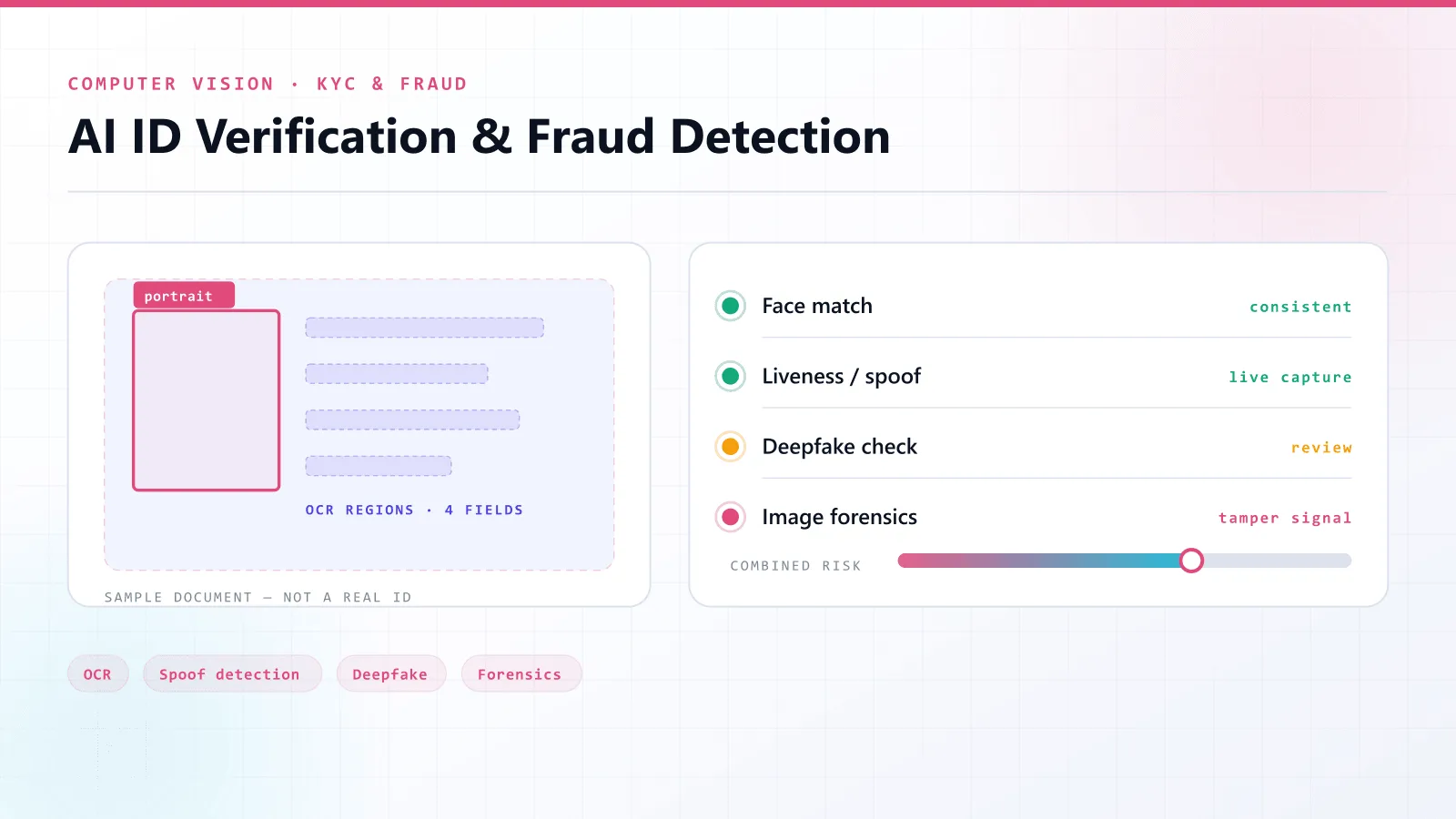
An identity verification pipeline built in a professional setting, combining computer vision, OCR, face analysis, presentation-attack detection, deepfake detection and image forensics to flag fraudulent identity documents and manipulated media.
- Year
- 2025
- Engagement
- Computer vision R&D and production ML
- Focus
- Computer Vision, AI/ML
- Status
- Delivered
01 — The problem
Remote onboarding means a business never meets the customer. Fraud arrives as a printed photo held to a webcam, a screen replay, a digitally retouched document, or a fully synthetic face. Any one of these passing verification is a compliance failure.
02 — Our solution
A layered verification pipeline. Each layer answers a narrow question — is this a document, what does it say, is the face live, is the media authentic — and a combined risk assessment is produced from their independent signals rather than a single opaque score.
How it works
The pipeline, step by step — from the first input to the final output.
- 01
Document detection
Detection models locate the document in frame, classify its type and correct perspective before any reading is attempted.
- 02
Text extraction
OCR reads the relevant regions; extracted fields are validated for structure and internal consistency.
- 03
Face analysis
The portrait region is located and compared against the submitted selfie for identity consistency.
- 04
Presentation-attack detection
Spoof models separate a live capture from a printed photo, screen replay or mask.
- 05
Synthetic media detection
Deepfake and AI-generated image detection models flag faces and documents that were never photographed.
- 06
Forensics & risk
Image forensics surfaces signs of digital manipulation; all signals combine into a reviewable risk assessment.
What we built
The outcomes
01
A multi-signal verification pipeline used in a production KYC context
02
Independent, explainable signals rather than one black-box decision
03
Detection coverage spanning physical spoofing and synthetic media
Challenges we solved
Attacks move faster than datasets
Generative models improve continuously, so a detector trained once decays. Retraining and evaluation had to be treated as a standing process, not a milestone.
Both error types are expensive
A false accept is a fraud loss; a false reject is a lost customer. Thresholds were tuned against that trade-off rather than accuracy alone.
Real-world capture quality
Production images are blurry, glared, cropped and low-light. Robustness under degraded capture mattered more than benchmark performance.
Technology stack

Want results like these?
Book a free 30-minute discovery call. We'll map out your project, recommend the right stack and send a fixed quote within 48 hours.