CricketVision AI
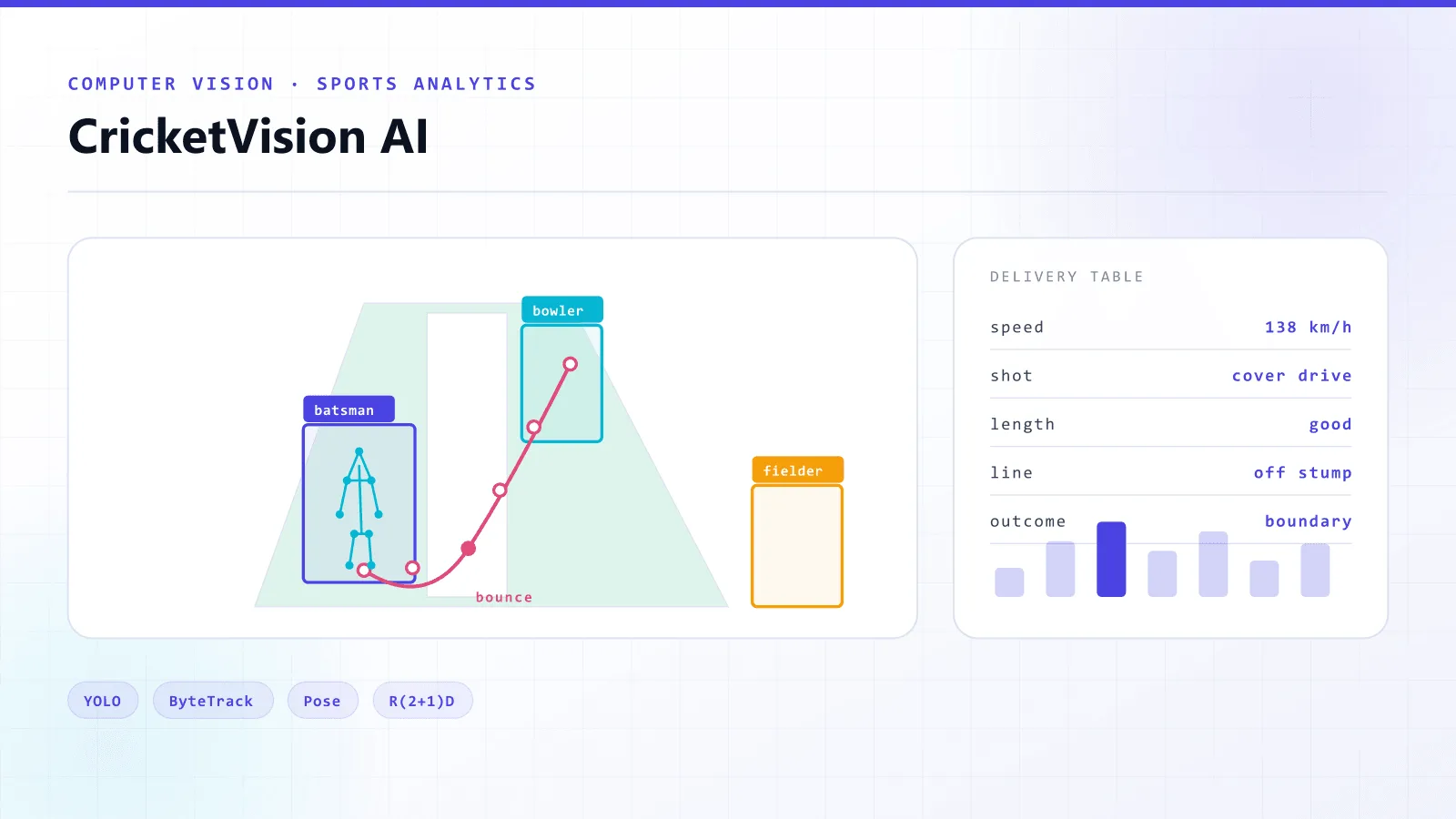
An end-to-end computer vision platform that detects and tracks players and the ball, reconstructs ball trajectory, reads batting pose, classifies shots, infers cricket events, and rolls everything into per-delivery analytics behind a REST API and a web dashboard.
- Year
- 2025
- Engagement
- Research, engineering and deployment
- Focus
- Computer Vision, AI/ML
- Status
- Open source
01 — The problem
Cricket analysis is still largely manual. Coaches and analysts watch footage frame by frame to note deliveries, shots and field placements. The raw signal — where the ball went, how the batter moved, what shot was played — is locked inside pixels, so nothing downstream can query it.
02 — Our solution
A staged vision pipeline that converts video into a delivery table: one structured row per delivery, from which every analytic is computed. Each stage is independently testable and swappable, and the whole pipeline is exposed through a REST API with a web dashboard on top.
How it works
The pipeline, step by step — from the first input to the final output.
- 01
Detection
A trained YOLO detector locates ball, batsman, bowler, fielder, wicket, wicket-keeper and umpire on every frame.
- 02
Tracking & roles
ByteTrack / BoT-SORT hold persistent identities across frames; geometric rules then assign cricket roles to those tracks.
- 03
Ball trajectory
A dedicated ball pass feeds trajectory reconstruction — Kalman filtering, gap interpolation and bounce detection — plus release, mean and max speed.
- 04
Pose & shot classification
COCO-17 keypoints give joint angles and batting-technique features; an R(2+1)D-18 video action model classifies ten cricket shots.
- 05
Event detection
delivery_start, ball_bounce, bat_contact, shot, fielding_event and boundary events fire with confidences attached.
- 06
Analytics & delivery table
Shot distribution, pitch maps, heat maps and statistical tests are computed from the per-delivery table and served via API to the dashboard.
What we built
The outcomes
01
A reproducible pipeline — every documented figure regenerates from a script
02
Experiments documented with what each number measures and excludes
03
Structured per-delivery output that downstream analytics query directly
04
Containerised API and dashboard ready to run on new footage
Challenges we solved
The ball is tiny and fast
At broadcast resolution the ball occupies a handful of pixels and disappears for whole stretches. A separate detection pass plus Kalman filtering and gap interpolation reconstructs a continuous flight path from an intermittent signal.
Unsegmented footage is harder than clips
A model that classifies pre-cut clips well degrades on continuous video where boundaries are unknown. Measuring end-to-end rather than clip-level accuracy kept the evaluation honest.
Pixels are not metres
Speed in pixels per second is meaningless across camera angles. A pitch homography converts to km/h where calibration is available, and the pipeline reports uncalibrated units where it is not.
Technology stack
Want results like these?
Book a free 30-minute discovery call. We'll map out your project, recommend the right stack and send a fixed quote within 48 hours.