Real Estate Platform with ETL & Scraping
A Django application built on aggregated property data from multiple websites. Data was collected through scraping and APIs, put through an ETL process, and then surfaced through the Django site.
- Year
- 2024
- Engagement
- Backend & data engineering
- Focus
- Backend, Data Engineering, Full Stack
- Status
- Open source
01 — The problem
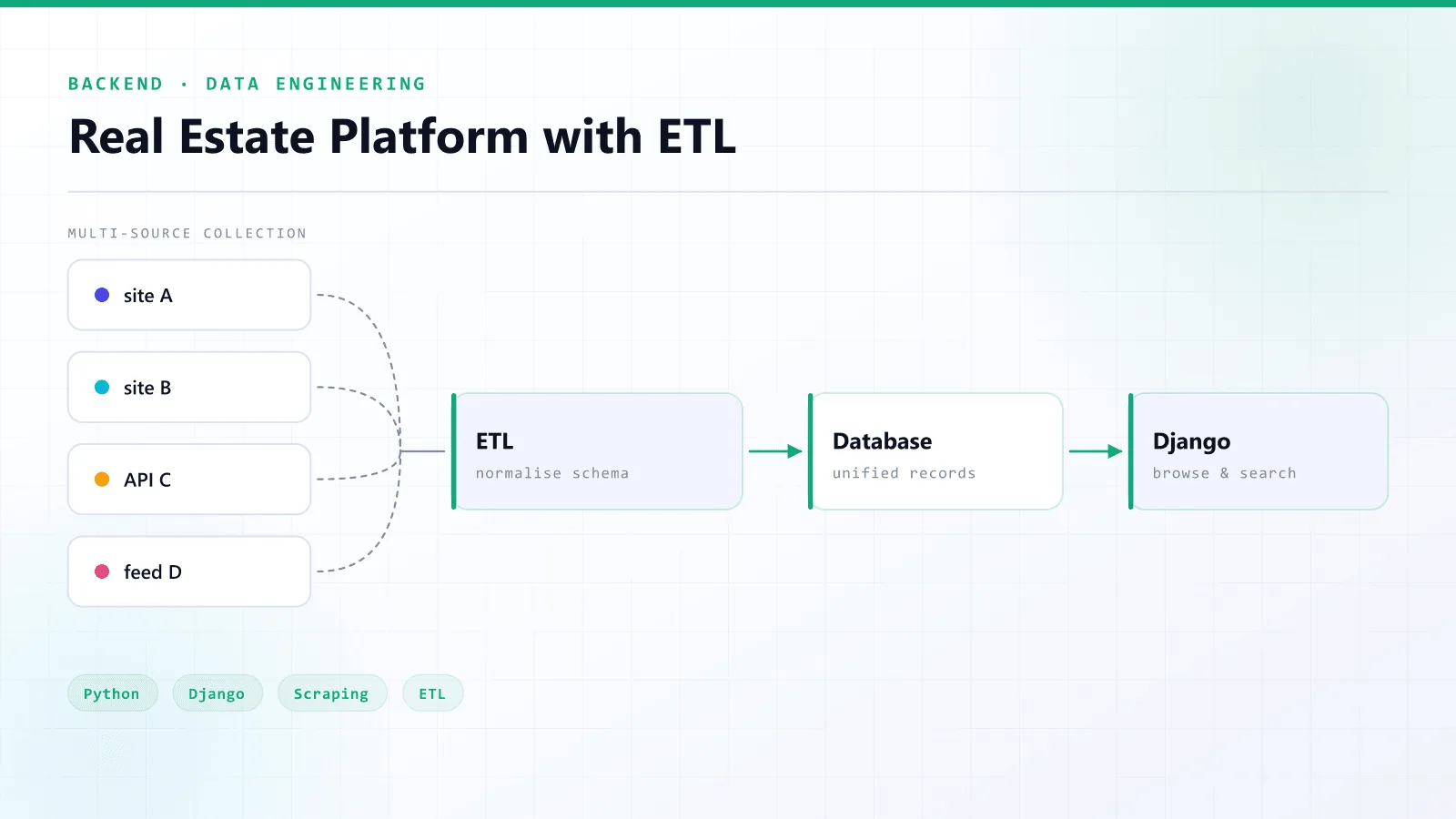
Property listings live on many sites in many shapes. Comparing them requires collecting them first, and then reconciling formats that agree on nothing.
02 — Our solution
A collection layer using scraping and APIs, an ETL stage that normalises everything into one schema, and a Django application that serves the unified result.
How it works
The pipeline, step by step — from the first input to the final output.
- 01
Collection
Listings are gathered from multiple sources via scraping and APIs.
- 02
Transform
ETL normalises differing formats into a single schema.
- 03
Storage
Clean records are persisted in the application database.
- 04
Application
Django serves browsing and search over the unified dataset.
What we built
The outcomes
01
One browsable dataset assembled from many sources
02
A repeatable collection-to-application pipeline
Challenges we solved
Every source disagrees
Field names, units and completeness vary per site. The transform stage carries most of the complexity.
Technology stack
Want results like these?
Book a free 30-minute discovery call. We'll map out your project, recommend the right stack and send a fixed quote within 48 hours.