Automated WordPress Post Creation
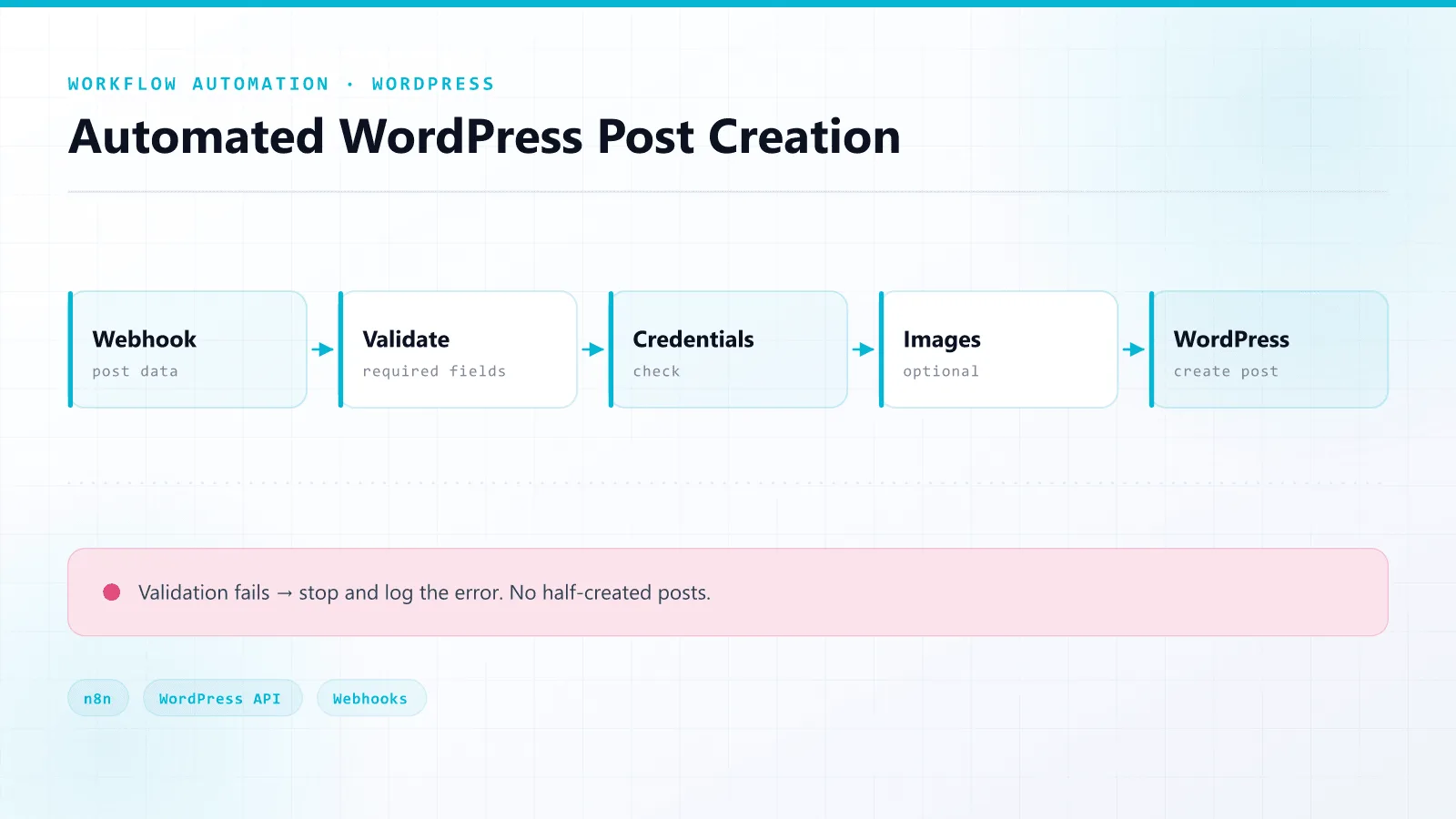
A workflow that receives a webhook request containing WordPress post data such as title, content, property ID and optional images. It validates the payload for required fields, checks that WordPress credentials are available, and stops with a logged error when validation fails.
- Year
- 2025
- Engagement
- Workflow automation
- Focus
- Automation, Backend
- Status
- Open source
01 — The problem
Systems that need to publish to WordPress — listings tools, CRMs, internal apps — each end up writing their own fragile integration, and each one fails differently when a field is missing or a credential expires.
02 — Our solution
One hardened webhook that owns the WordPress contract. It validates the payload, confirms credentials before attempting anything, handles optional images, and fails loudly with a logged error instead of half-creating a post.
How it works
The pipeline, step by step — from the first input to the final output.
- 01
Webhook intake
Post data arrives: title, content, property ID and optional images.
- 02
Payload validation
Required fields are verified before any external call is made.
- 03
Credential check
WordPress credentials are confirmed to be present and usable.
- 04
Image handling
Optional images are processed and attached where supplied.
- 05
Post creation
The post is created through the WordPress API and the outcome is returned.
What we built
The outcomes
01
A single reusable publishing endpoint for multiple callers
02
Predictable, logged failure behaviour
03
Text and image posts handled by the same flow
Challenges we solved
Optional means two paths
Images being optional doubles the flow. Both paths had to be equally reliable rather than one being an afterthought.
Failing safely
Stopping before partial creation matters more than trying to salvage a bad payload.
Technology stack
Want results like these?
Book a free 30-minute discovery call. We'll map out your project, recommend the right stack and send a fixed quote within 48 hours.